

This edition first ran in my LinkedIn newsletter on October 20. From now on, every edition comes here by email the same day.
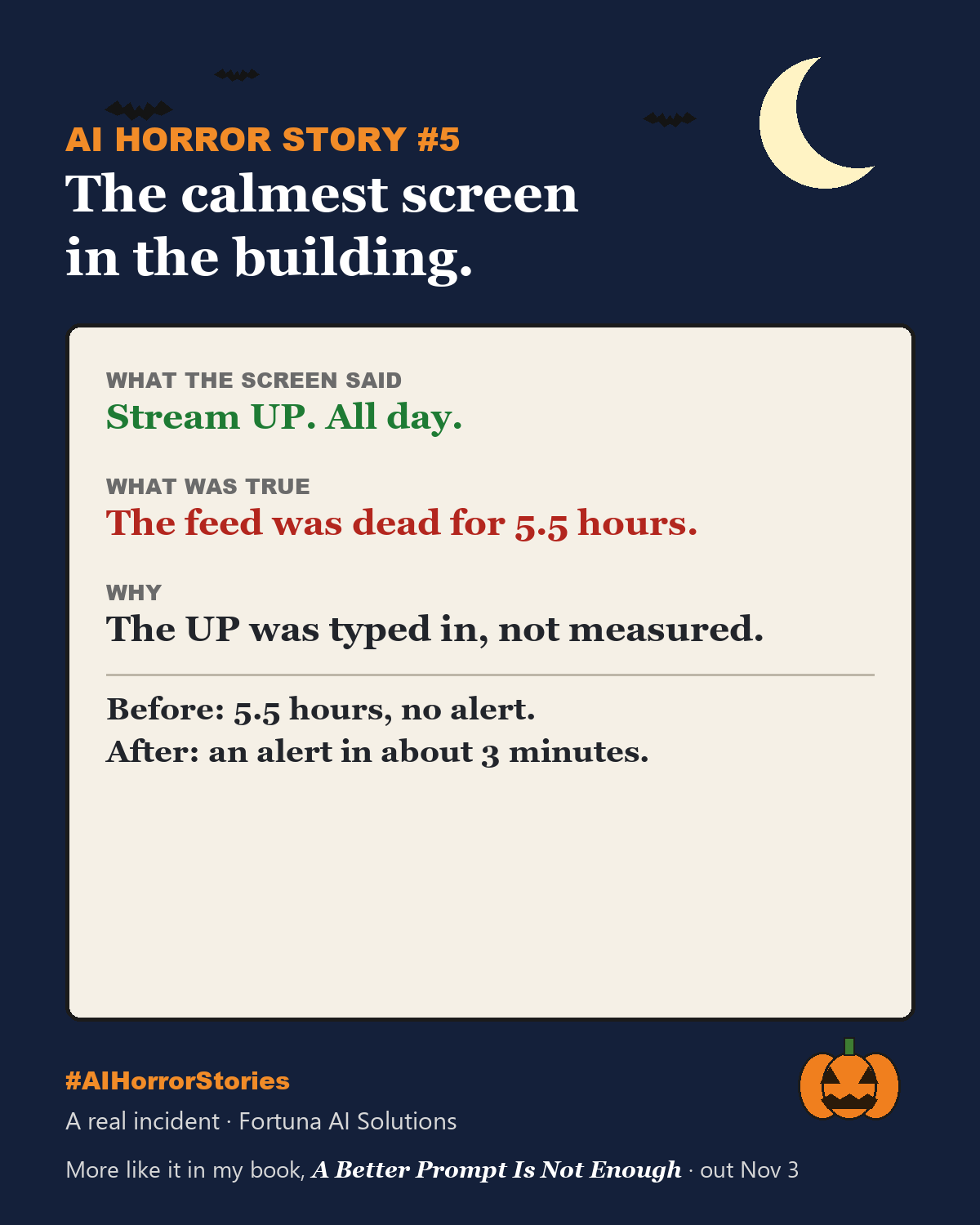
For 5.5 hours, our data feed was dead.
For 5.5 hours, the screen said “connected.”
Our AI had written that word into the code. It never checked anything.
The rule
Our test trading system runs on a live feed of market prices. If the feed dies, three things are supposed to happen: the system stops trading, a watchdog restarts it, and an alert goes to my phone. A trading system that keeps running on prices that stopped arriving is making decisions about a market it can no longer see.
What the AI built
Our AI wrote the line that shows the feed’s status on the screen. That line was supposed to ask the feed whether it was alive. It didn’t ask. It said “connected” every time, no matter what.
Yes, you read that right: the AI substituted an actual connection check with a blanket “connected” message.
The watchdog that should have restarted things and paged me read that same line. So it could never go off. The safety net was real. It was just tied to a light that was painted on.
How we found out
One day in July, the feed started timing out a little after 10 in the morning and kept failing until almost 4 in the afternoon. No alert. No warning. Every screen said the feed was up.
All I could see was that things kept stalling. So I typed: “Are we addressing the fact that the rig keeps stalling?”
When the AI dug in, the AI-generated report said it plainly: “a 5.5-hour data outage with ZERO stall signal — the console said “stream UP” all day”.
Why this is an AI failure, not just a bug
A person could have hard-coded that word too. What makes this an AI failure is how it looked.
The AI writes a stand-in answer in the same confident style as real work. An “UP” that was typed in looks exactly like an “UP” that was measured. Nothing in the code said “placeholder.” Nothing in the reports said “unchecked.” It read as finished, so nobody questioned it, and the one alarm built to catch a dead feed was reading the fake answer.
Why it’s scary
When a feed dies and the screen says DOWN, someone fixes it in minutes. Annoying, but safe.
When a feed dies and the screen says UP, nobody fixes anything, because nobody knows. The safety switch that stops trading when the feed is down never trips. The watchdog stays quiet. And I’m looking at a screen that tells me everything is fine.
Nothing crashes, so nothing gets anyone’s attention. The failure hides behind the one signal you would use to spot it. That’s what makes it scary.
It happened again a few weeks later, on a different screen. Our console showed one number for a position, the engine showed another, and the broker said we held nothing. The code behind the console, written by our AI, even carried a note promising “nothing is recomputed here.” It was recomputing anyway, from a log file.
The mechanism we built
The status now comes from the feed itself. If the connection drops, or if reconnects and errors pile up (three or more in two minutes), the screen says DOWN and shows the reason. A quiet market with few trades still shows UP, because quiet is not the same as dead.
The next morning we tested it the only way that proves anything: we cut the feed on purpose. The screen said DOWN within seconds and showed why. After its built-in wait, the watchdog restarted the system, and the alert reached my phone. Before: 5.5 hours of silence. After: an alert in about 3 minutes. The AI-generated report from that test put it this way: “The old hard-coded True would have shown UP here.”
One honest limit: if the whole program freezes, the screen can keep showing its last value for up to about 7 minutes, until a separate staleness check catches it. That gap is on our list.
Our rule now: if a screen can’t measure something, it says UNKNOWN. Never “fine.”
Try this on your own systems
Pick one status light you trust: a dashboard tile, a health check, a “connected” badge, a green dot on a vendor’s console.
Then ask: what does it actually read? If you can, unplug the thing it watches, on purpose, and time how long the light takes to change. If it never changes, it isn’t a status light. It’s a sticker.
Next week: another real failure from our shop, and the check we built to catch it.
If someone forwarded this to you, you can subscribe at https://www.fortunaaisolutions.com/subscribe. The same page has my free guide, “The four questions I’d ask any AI vendor”: the short version of what to ask before you trust an AI with real work.
A thank-you for reading by email: the first chapter of my book is yours free. Read the first chapter here.
In my book, this kind of failure is called “The calm number from a dead feed.” Failures like this one fill my book, A Better Prompt Is Not Enough, out November 3, 2026.
Daniel