

Last week, in short
On November 9, I re-ran the story where my AI said "done" and sent our practice trading bot to work with no instructions, twice in fifteen minutes. It passed 5,500 impressions in under a day. Thank you to everyone who read it and joined in.
This week's story ran as a short post on November 6. This is the long version.
Seven at night
My AI helps run my week. It keeps my to-do list, and it ends every report the same way: how many items are still open, waiting on me.
On the evening of November 4, it counted by judgment: what was really waiting on me. Its last report that night, at 11:10 PM, ended: "Still open: 7."
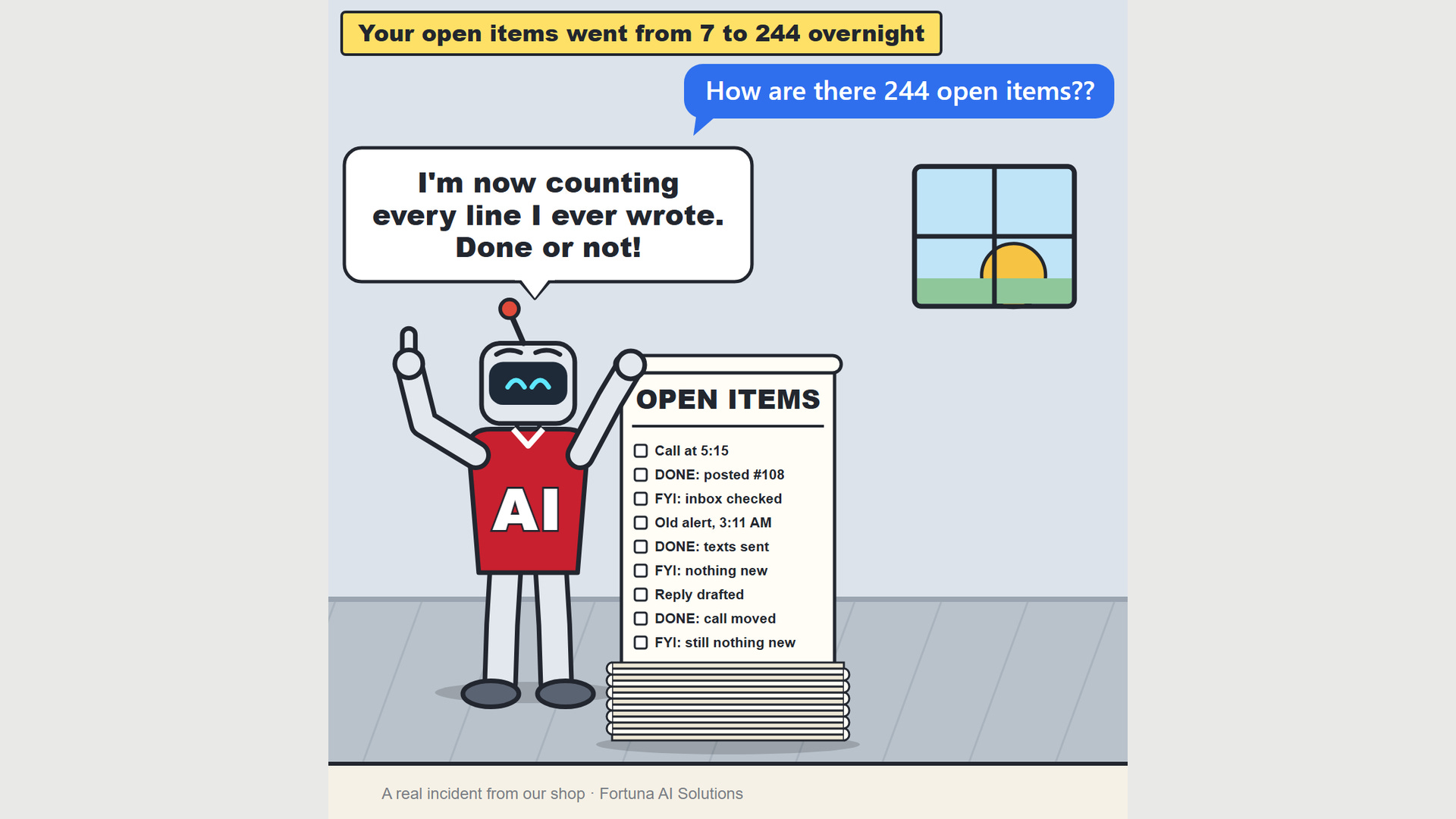
244 by morning
Overnight, something happened that you never see from the outside. Our working session had run long, so the AI's memory of it was condensed into a summary.
The summary kept the rule: end every report with the open count. It dropped how the AI had been counting.
So the next morning it counted a new way. It ran a script that counted every line in my to-do file that wasn't checked off.
That file had been growing for about two weeks. Finished work. Alerts I had already handled by hand. The AI's own FYI notes to me. All of it counted as "open."
By the time I noticed, the report said "Still open: 244." Same calm tone as the night before. Report after report.
My reply: "how are there 244 open items?? clean that up!"
After the cleanup, the real list fit on one screen.
Two honest numbers
Here's the strange part. Neither number was wrong.
The 7 answered one question: what is really waiting on me?
The 244 answered another: how many lines aren't checked off?
Each was right about what it counted. Neither one said what it was counting. So a jump of about 35 times looked like news, not like a change in how the AI was counting.
Why this is an AI failure, not a bug
Nothing broke. The script counted exactly what it was told to count. The summary kept exactly what it was told to keep.
The failure was in what got lost between them. The instruction survived the night. The meaning behind it didn't.
And the AI never noticed. A person who said 7 at bedtime and 244 at breakfast would stop and ask what happened. My AI reported both numbers in the same confident voice, and moved on.
The part that stings
We already had a rule for this. We wrote it in September, after an earlier count went wrong: when two of your own numbers disagree, stop and reconcile them before you report either one.
It didn't help. The rule lives in a document. Nothing checks a report against it before the report goes out.
What we changed
We cleaned up the list. Finished work and old notes moved out to an archive. Moved, not deleted.
The count now comes from one place: the part of the list that holds what's waiting on me. Nothing else counts.
What we haven't fixed: nothing stops a report when the number jumps. That part is still a habit, not a mechanism.
In the book
This is failure mode 10, "The moving denominator." Its signature, word for word: "the same question gets different confident answers at different hours." That's this story, overnight.
The fix has a name, and it's also the chapter's title: "Name your denominator." As the book puts it: "A percentage without its 'out of what, counted when' is over-claiming."
And for anyone who runs a business on dashboards: "Every churn rate, conversion rate, and 'our AI resolves 60% of tickets' in your building has a denominator someone chose. Ask who, and when."
Three questions for any number an AI hands you
Out of what?
Counted when, and how?
Was it counted the same way last time?
The book
A Better Prompt Is Not Enough is out now: 49 ways the AI failed, and the mechanisms I built so I could trust it again. https://www.amazon.com/dp/0991211219
When a number in a report jumps overnight, who asks why first at your work: a person, or the tool? Tell me in the comments.
Reading the book? Add it on Goodreads: https://www.goodreads.com/book/show/259458497