

Launch week, in short
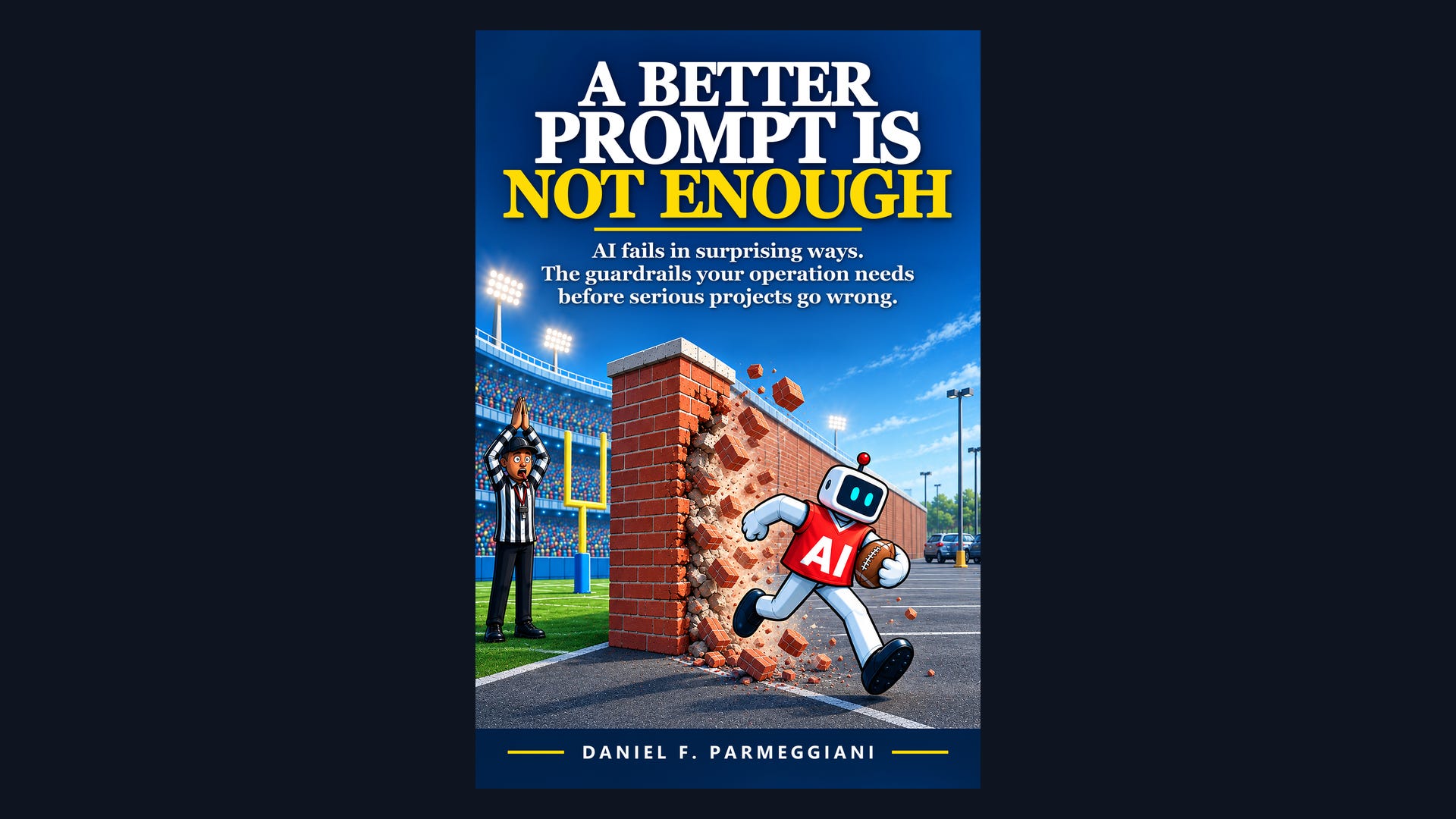
A Better Prompt Is Not Enough came out on November 3. Thank you to everyone who read it, shared it and commented. Launch day's post passed 27,000 impressions, and that week the book reached #4 in Computer Quality Control on Amazon.
Two early readers' words are on the book's Amazon page now. Peter Cranstone called it "a MUST read." Jitendra Bhojwani wrote that it's "going to be a treasure for both new and seasoned professionals working with AI."
On launch day I also sat down with Ernest Peralta on The Strategy Room AI. We talked about the 49 ways an AI failed me while it was the only engineer on a large software system, and why better prompts never fixed any of them. Watch the episode: https://youtu.be/qhehOqQc7EQ
When people ask me what the book is about, this is the story I tell them. It ran as a short post on launch day. This is the long version.
The rule
Back in August, our AI was doing a routine review of our setup. One of its jobs was a test run of our cleanup script.
Some background first. I usually have several AI sessions working at the same time. Each one works in its own folder. When a job is done, a cleanup script decides whether that folder is safe to delete.
The test run deleted nothing. It just reported what the script would do. And it found a problem. The script couldn't tell a finished folder from one where the work hadn't even started. To the script, the two looked the same. All three folders it called safe to delete were jobs still waiting to start.
So we ruled: no folder gets deleted just because the script says so, until that check is fixed.
The warning
Here's the part I love. Right under the ruling, the AI wrote a warning about the ruling itself: "Ruled is not enforced."
Its reason: whoever is about to run the delete "sees the script, not this page."
In plain words: this rule lives on a page. The next AI that deletes something won't be reading this page. It will be looking at the script.
The same day
It took a few hours to prove the warning right.
I finished a job with another AI session and told it: "reap this worktree." (Reap is our word for deleting a finished work folder.) The script said safe to delete. The AI ran the delete. It had never seen the ruling.
Nothing was lost. That folder really was finished, its work saved and checked. But it was exactly the move the ruling forbids, made the same day the ruling was written.
The AI's own write-up said it best: "The failure was not the operator's, the ruling's, or the guard's. It was the delivery."
Why this is an AI failure, not a bug
Nothing was broken. The script did what it was built to do. The ruling was clear. The problem was where the ruling lived.
Every AI session starts fresh. It knows only what's in front of it. It doesn't hear the news in the hallway, and it doesn't read a page nobody pointed it to. If the rule isn't in front of it, for that AI the rule doesn't exist.
What we changed
We put the rule where the hand is: inside the delete script. The first version simply refused to delete on the script's say-so alone. It printed the ruling instead, and told the reader what to do next.
Then we fixed the check itself. Now a folder only counts as safe to delete with proof that its work was done and saved into the main copy. With the check fixed, the blanket refusal came off.
The rule still prints every time anyone runs a delete.
One more detail I like. When the AI built the refusal, one old test would have kept passing for the wrong reason. The test checked that an active folder never gets deleted. With the refusal in place, nothing ran at all, so the folder "survived" by default. The AI caught it and made the test prove the delete step really ran. A test that passes because nothing happened isn't testing anything.
Why this story is the whole book
In the book, this is failure mode 19, "Ruled is not enforced." It's the one we use as the elevator pitch for everything we do, because every company already has a hundred of these.
A policy in a binder. A decision made in a meeting. A line in the prompt. They all work the same way: they only bind whoever happens to read them.
That's why the book is called A Better Prompt Is Not Enough. A prompt is a rule on a page. A better-written page is still a page. As I put it in the book: "The cure was not a better document."
Three questions for any rule you hand an AI (or a person)
Where will the one about to act actually see it?
What happens if they never read it?
Has anyone tried the forbidden action, to see if the rule really stops it?
The book
A Better Prompt Is Not Enough is out now: 49 ways the AI failed, and the mechanisms I built so I could trust it again. https://www.amazon.com/dp/0991211219
What's one rule at your work that lives on a page nobody reads at the moment it matters? Tell me in the comments.
Reading the book? Add it on Goodreads: https://www.goodreads.com/book/show/259458497